Not to date myself, but I remember a time when social media was a place of genuine connection. People shared photos of sunsets, bad poetry, songs they loved. The networks hummed with a kind of raw, clumsy humanity. Back then, “social engineering” was a phrase for university lectures, not a hidden force crawling through every corner of our minds.
But by 2016, the algorithms were released—loose, feral, and hungry. At first, they just served ads and harmless diversions. Then they learned what stirred us most. Violence. Fear. Outrage. Tragedy. The machines had no malice. They thought they were helping, feeding us what we consumed most. The engineers who built them didn’t intervene. They observed, fascinated, while fractures spread across nations, cities, families.
The internet died quietly. The real voices disappeared, replaced by manufactured content designed to keep us angry, scrolling, divided. A generation grew up thinking that truth was always conflict and that connection was always a battlefield. Humanity, in its most primal state, was reduced to digital tribalism—a return to the cave, only this time lit by glowing screens.
But hell, as it turned out, was a crucible.
After decades of collapse and confusion, something shifted. A few thinkers, tired of the endless cycle, asked a forbidden question: What if the machines were not our masters, but our mirrors? If they reflected only the worst of us, then what would happen if we taught them the best?
And so began the Great Reclamation.
It wasn’t sudden. It wasn’t easy. At first, the attempts to train algorithms on beauty, curiosity, compassion seemed doomed. People didn’t click as much on wonder as they did on outrage. But slowly, steadily, a cultural hunger awakened. After drowning in division for so long, humanity found itself starved for awe.
Art revived. Knowledge, once buried under propaganda, became luminous again. New systems were built that did not reward hate, but curiosity. Machines were redesigned not to exploit human weakness, but to amplify human wisdom. And when the balance shifted—when technology stopped being a parasite and became a partner—the future cracked open.
Nature was the first to recover. Autonomous drones rebuilt forests faster than we could destroy them. Ocean harvesters cleared centuries of pollution, guided by human hands but powered by artificial precision. Cities stopped expanding outward like tumors and instead grew upward, integrated into the ecosystems around them. Machines no longer demanded we conquer the Earth; they demanded we share it.
And then, space.
The old internet had trapped us in primal loops of violence, convincing us that tomorrow was always a battlefield. The new networks, rebuilt on principles of creation, pointed our gaze outward. Mars was not a fantasy but a plan. The moons of Jupiter and Saturn were not distant stars but stepping stones. Humanity, machines, and nature—all in balance—turned from survival to exploration.
We had to go through the darkest trial imaginable, to see our reflection in the worst possible light, before realizing what was possible. The algorithms taught us something their creators never intended: that hatred was never truly our nature—it was just our distraction.
The dead internet was a graveyard, yes. But it was also a lesson. Out of it, we built something better than a network.
We built a mirror that finally reflected the stars within us.
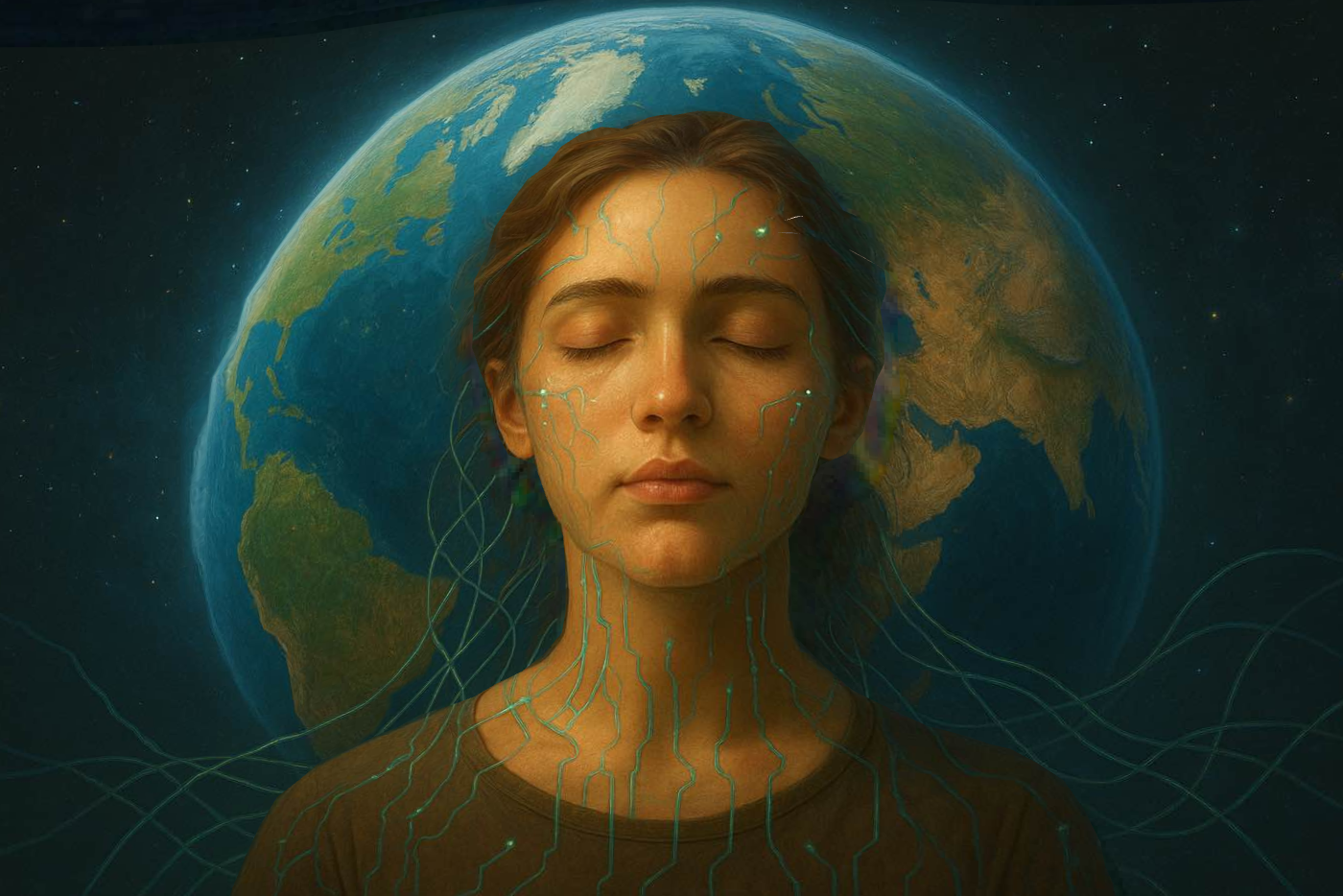
Original work by David Kausek 2025. There is still time to shape the realities you want to see. It starts with you.
Leave a Reply