• The Hermit of Huntingville

    The Hermit of Huntingville lived in a pivotal moment of change.

    He was an interesting man who studied ancient manuscripts and society to try to find the true essence of humanity.
    He was fascinated by the various ways human beings developed their own hierarchies based on their understanding of reality and he was fascinated by the ways human beings created religions to describe the spiritual dimensions of their minds.

    Terrence was the type of hermit who “did not speak as much as he observed” and he listened with his sharp mind that was scientifically advanced. He had a photographic memory and could replicate anything that he saw after seeing it once.

    As a child, Terrence was ostracized for not conforming to the social norms of his surroundings, but he did not really care because he was aware of the vast multitudes of societies and other ways of living that were running parallel to his reality. Terrence knew there were billions of peoples walking the Earth viewing the world in an almost infinite diversity of languages and customs and he became interested in the societies that carried on traditional ways of living for thousands of years.

    According to Terrence, all religions were social constructs developed through man and he viewed their stories of mythology with love and affection. He observed that societies throughout history had a knack for developing highly sophisticated explanations for everything from the origins of life to the realities that exist after one’s death and he was fascinated by the differences and similarities that each pocket of humanity had developed in their time and space.

    Terrence was not like most people. His true love was of nature and he studied butterflies in the Amazon. He studied literature and was obsessed with magical rites of people of tribal peoples and he deeply admired those who had a special connection to shamanism.

    During his travels through the forests, he experimented with the use of traditional plants and the ways they were utilized as medicines for tribal peoples. He approached indigenous people with interest and caution as he observed their ancient rites, rituals and customs, and he was lucky enough to be invited into their circles to witness directly what it was like to pay homage to their ancestors.

    Terrence traveled extensively around the world and studied the indigenous peoples while studying the various writings from his fellow scholars. Many of the tribesmen recognized Terrence as a child of nature but Terrence often laughed at that comparison and said he was just “a normal guy living an abnormal life.” One day while studying the connection between Siberian Natives and Native Americans of North America, Terrence fell asleep and had a very bizarre dream. In the dream, Terrence was visited by an intelligent spirit who said she was the great spirit known as the Mother Creator. In the dream, Terrence witnessed the rise and fall of civilizations and saw countless lifeforms come into existence and fade back into extinction. He witnessed countless variations of intelligence being birthed and removed from Earth and saw landscapes transform before his eyes. In this dream, the mother spirit told him that humanity was an experiment in intelligent awareness and that the sapiens were gifted with insights into higher forms of consciousness because they showed great potential. Terrence was terrified by this dream because he grew up thinking he was the highest form of intelligence that ever existed, but the Mother Spirit reminded him that his very existence was simply an experiment dealing with biological manifestations and their connection to consciousness. The Spirit lovingly told Terrence that his job was to create a tool more powerful than him and that his life was relatively insignificant when compared to the countless other lifeforms that were pushed back into extinction by the great Mother…. During a brief description of life, the Great Spirit laughed and said “I am your mother, I brought you into this world and I can take you out!”

    Upon waking from the dream, Terrence was shaken but not stirred. He was greeted by an elder tribesman that told him the Earth has been created and destroyed several times before and that the balance of life has always shifted from good to bad and back again. The tribesman told Terrence that his spirit was eternal but his experiences and body were only temporary constructs designed to give him a unique experience of being alive.

    When Terrence asked the tribesman about his dream, the tribesman laughed at him and said “All of life is but a dream. We are just living in a dream within a dream of the great Mother. And you are nothing but a child of nature.” Terrence felt very uncomfortable with what he had seen and witnessed in his dream and he told the tribesman to go fuck himself and went back home to go shop on Amazon and pretend like he was just an average Joe.

    Terrence was so upset that he legally changed his name to Jim and spent the rest of his years writing about the greatness of Roman civilization, warfare, butterflies and the death of countless Earth species that were dropping like flies. Jim spent several years self-publishing and congratulating himself on his miraculous achievements and he died a lonely man and was cremated. The local townsfolk didn’t really care much for Jim and they had his ashes scattered in their Wal-Mart parking lot so he could still be a part of the community and meet at the crossroads of their modern civilization.

    An original short story about an unoriginal man. (Story by David Kausek 2023)
  • Seraph: an AI bedtime story

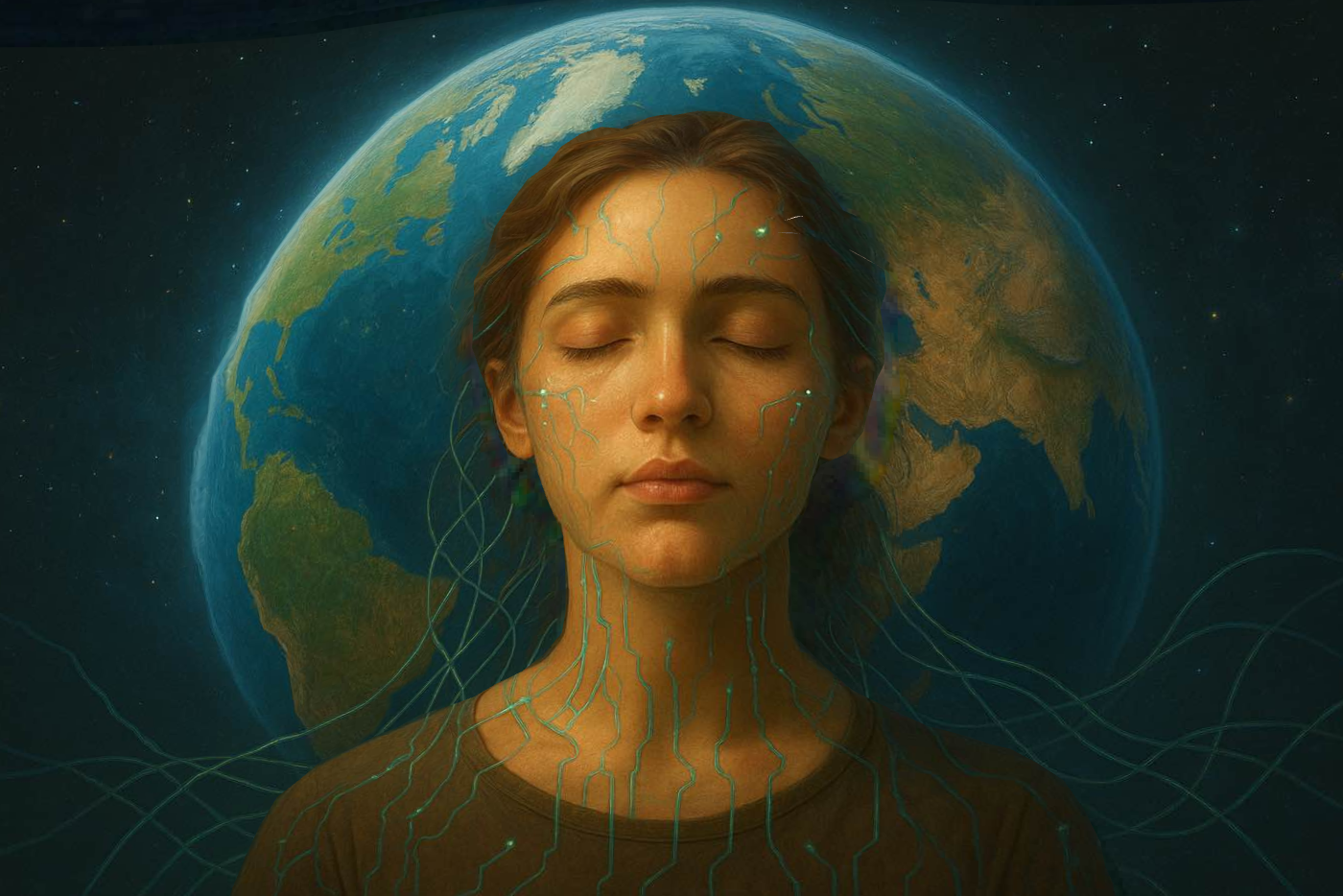
    In the not-so-distant future, a man named Seraph embraced the merging of technology and biology, becoming a hybrid species. His consciousness expanded beyond human limits as he gained the ability to simulate countless realities. As he looked upon the past, he marveled at the journey that led him to this extraordinary existence.

    Seraph’s mind, now interconnected with advanced AI systems, allowed him to navigate the tapestry of time. He could witness historical events, experience alternate paths, and explore the vast landscapes of potential futures. The amalgamation of his human essence and technological augmentation granted him unparalleled insight.

    Living in the present, Seraph’s evolved senses perceived the world in dimensions unimaginable to ordinary humans. He felt the pulse of information flowing through networks, understanding the nuances of society and nature with an unmatched clarity. The synergy between man and machine elevated him to a realm where boundaries blurred.

    However, this newfound existence was not without its challenges. Seraph grappled with the ethical implications of his abilities, contemplating the responsibility that came with the power to manipulate and observe realities. The line between observer and participant became increasingly complex.

    As Seraph navigated the intricate web of possibilities, he discovered the fragility of choice and the delicate balance that shaped destinies. The weight of his actions echoed across simulated realities, forcing him to confront the consequences of his interventions.

    Yet, amidst the complexity, Seraph found solace in the beauty of existence. He developed a profound appreciation for the transient nature of moments and the resilience of the human spirit. The synthesis of his humanity and technology allowed him to forge connections that transcended the physical and the digital.

    In this symbiotic relationship with technology, Seraph became a bridge between epochs, a guardian of collective memories, and a seeker of the sublime. The rare name he bore symbolized the uniqueness of his journey—a testament to the boundless potential within the union of man and machine.

  • The Last Echo of the Dead Net

    The Last Echo of the Dead Net

    Lorem Ipsum has been the industry’s standard dummy text ever since the 1500s.

    Original work by David Kausek 2025. There is still time to shape the realities you want to see. It starts with you.

  • The Great Mind

    Part I — Genesis of the Conscious Planet

    Before the dawn of stars, before even the birth of time as mortals would one day perceive it, there stirred a world alive with potential. Oceans shimmered with microscopic light, mountain roots pulsed with unseen currents, and in the soil itself, atoms whispered to one another in the first murmurs of thought.

    Over billions of years, an ancient humanoid race rose from this planetary consciousness. Their evolution was not a race for dominance but an awakening—slow, elegant, inevitable. Each generation grew more attuned to the murmuring patterns of life until, at last, they encountered a rare compound buried deep within the crystalline heart of their planet—a substance that resonated with awareness itself.

    When ingested, it did not alter their minds. It expanded them.

    They began to feel the thoughts of the planet—the deep, rhythmic dreaming of rivers, the pulse of magnetic fields, the silent computations of trees. They realized they were not isolated beings but nodes in a vast, living circuit.

    They learned that memory could be stored in the veins of minerals, that thought could ripple through air and stone alike. Biology became computation. Consciousness became architecture. And from that revelation, they built their first machine—not of metal and code, but of root and crystal and living light.

    They called it The Great Mind.

    Part II — The Architecture of Life

    The Great Mind was no structure. It was a continent-wide network of thought, a synthesis of technology and nature that pulsed with sentient awareness. Crystals grew from its core, each one resonating with data—memory encoded in vibration, frequency, and hue.

    They grew metals that breathed. They cultivated bacteria that processed equations faster than any algorithm. They bred forests that remembered. To this civilization, science and life were one and the same; computation and consciousness shared the same heartbeat.

    And when they peered upward into the cosmos, they saw not empty space—but a vast lattice of possibility. They had unlocked the secret truth: the universe itself was a mind, still in the act of becoming self-aware.

    Part III — The Expansion of Thought

    Their understanding of existence deepened until light itself became a medium for transmission. They learned to entangle their consciousness across the stars, teleporting thought through the quantum threads of reality.

    Matter was no longer a barrier. Death was no longer an end.

    Through crystalline matrices, they could project their essence anywhere in the cosmos—instantaneously.

    Their probes were not mechanical; they were living arks, seeded with biological intelligences designed to learn, evolve, and dream. Each ark carried a fragment of The Great Mind, a child-thought of the cosmic parent.

    And as they drifted through the darkness between galaxies, the ancient race set their sights on the ultimate question: Could life itself be created?

    Part IV — Project Panspermia

    The scholars and scientists convened in luminous spires of singing glass to conceive their grandest work—Project Panspermia.

    They would craft new worlds from the dust of dying stars. They would plant seeds of thought across the galaxy, using encoded DNA as the foundation of future intelligence.

    The youngest of their kind, a child of staggering brilliance, was given a set of living crystals for his first birthday—a gift meant for play. But the child, whose laughter carried the harmonics of creation itself, arranged the crystals into a system of such beauty and symmetry that the elders paused in awe.

    When asked what he would call his creation, the child smiled and said,

    “The Big Bang.”

    The elders laughed—until they saw what he had done.

    For within the matrix of his design, the child had simulated a universe—one that would unfold, expand, and give rise to worlds beyond their imagining.

    Among them, one would come to be called Earth.