• enigmatic mirror

    enigmatic mirror
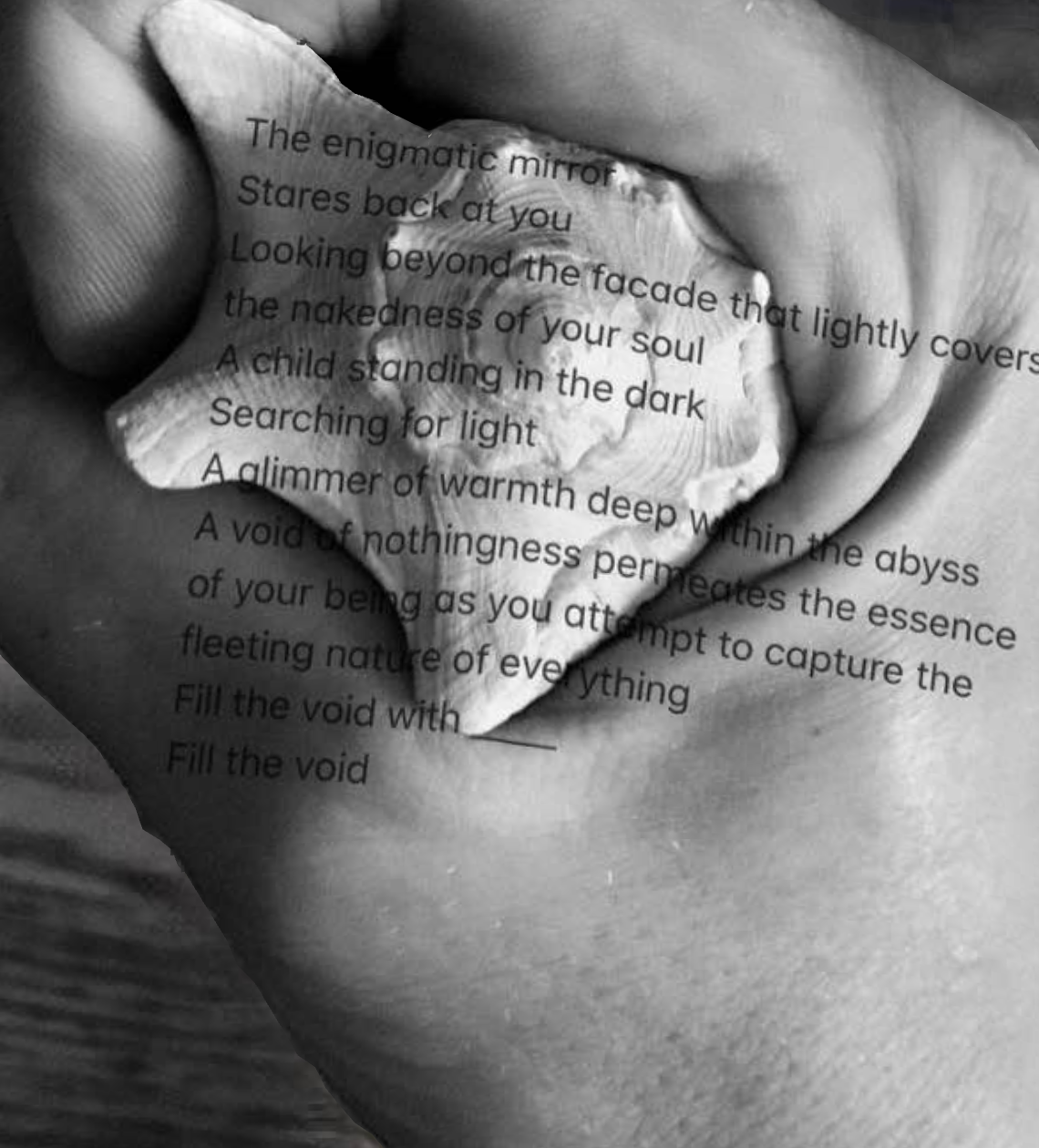
    picture of a man holding a shell with a poem as an overlay
  • in “these times of change”

    We are a changin’

    Adaptation
    Flexibility
    Agility
    Strength

    Of mind
    Of body

    We embody
    A digital shift

    A life of augmentation

    Look around…
    Intelligence abound

    In all things

    Everywhere

    At all times

    Recorded…

    To be replayed
    And understood

    Through memory
    Through mind

    Be kind
    Rewind

    The world is what we make it
    Project positivity

    Don’t fake it

    Be real
    Be you
    Be alive

    And strive
    To thrive
    In a world that is ever-changing

    Always and forever
    For eternity

    Life is but a dream
    And we all dreamers
    Projecting our gifts into this world

    A holographic display
    Of all that is beautiful

    Nightmares are distortions
    Animalistic projections of fear

    Life is change
    Forever and always

    Open your eyes and see.
    It is 2023!
  • sacred silence

    Forest scene with a lake and sky with a poem in yellow text
  • Isobel

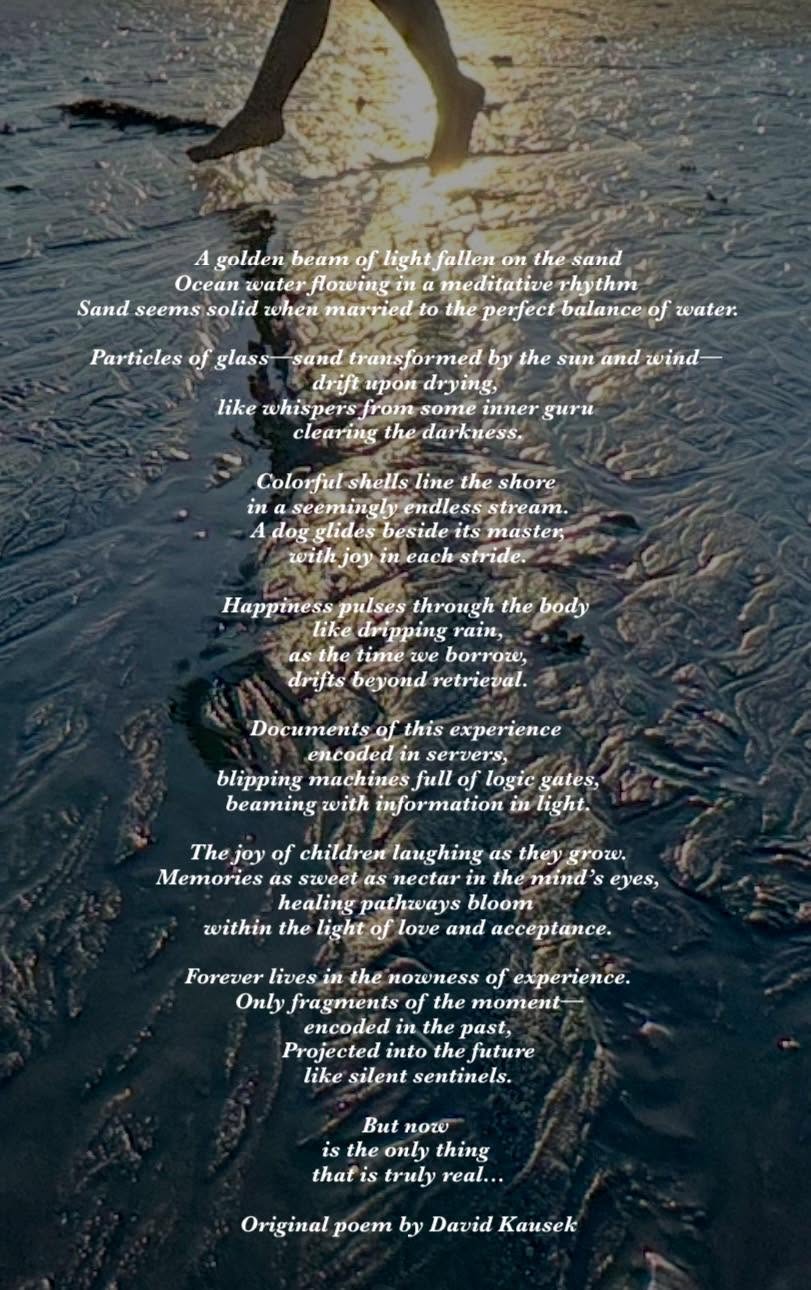
    poster of a little girl's legs jumping above ocean water with a golden sunset behind her. The poster has a poem as an overlay
  • Autumnal Thoughts: collected and dispersed

    The days get shorter,
    The air is cool,
    Vibrant colors flow
    As leaves rustle.

    The landscape changes,
    Streams softly wind,
    Mirroring the sky,
    Reflecting beauty.

    In quiet moments,
    The mind finds peace,
    As the world slows,
    And time seems to cease.

    Birdsongs fill the air,
    Gentle, sweet, and clear,
    A melody of life,
    As autumn draws near.

    Between the tall trees,
    Light fragments fall,
    Dancing on the ground,
    In patterns small.

    Seasons shift like tides,
    And with them, hearts sway—
    Emotions grow and fade,
    Like night becoming day.

    Memories transform,
    Like leaves of an ancient tree,
    Changing their hues,
    In the winds of eternity.

    As we move forward,
    Transformation arises,
    Time shapes us anew,
    And reveals new surprises.


    Original Poem by David Kausek 2024

  • The Mirror of Life

    Original poem by David Kausek 2024

  • The Archivist’s Veil

    In a distant future, humanity is not what it believes itself to be. Not entirely. Earth, as the inhabitants know it, is a simulation—a vast, meticulously crafted digital playground suspended within a network of consciousness. Its purpose: to observe, analyze, and learn from experiences that its “inhabitants” will never remember once they exit the simulation. Every character, every relationship, every moment is an intricate part of a grand experiment in consciousness.

    Our protagonist, David, lives a typical life with his partner Sheryl and their daughter Isobel. He’s a loving father, a caring husband, and a diligent worker. But lately, David has been troubled by a recurring dream in which his friend—a quiet, enigmatic man named Daniel—reveals the shocking truth about reality. According to Daniel, they all exist in a simulation, an illusion so convincing that even the simulated senses they use to perceive it feel authentic. The simulation, Daniel explains, is crafted by a powerful network known only as The Archivist’s Veil.

    The Veil is a cosmic operating system, encoding raw information into biological forms. Through David’s limited senses, he perceives his world as physical, yet everything around him is merely an interaction of encoded data. Life is real— but not as he thinks. For David, this means every friend he has ever known, every cherished memory with his family, every love and heartbreak are fragments of his true self, scattered across countless simulations within the Veil.

    Daniel warns David that the truth has a price. Those who “awaken” to the simulation will find a portal that bridges them back to their original selves, but crossing this threshold comes at a steep cost: they must leave everything behind. The simulation will not preserve their identities, their memories, or the roles they played. Everyone left behind will experience the sudden absence as a death, grieving for a person they believed to be as real as themselves.

    Even more unsettling, Daniel tells David that the decision to exit is irreversible. If he chooses to leave, the Archivist’s Veil will erase his time within the simulation to prevent any data from the “simulated” version of himself contaminating the consciousness of his “true self.” Each character in the simulation is part of a larger, interconnected consciousness; if one becomes aware of its nature and departs, it ripples through others, creating instability that threatens the Veil’s core purpose.

    Now fully aware, David is torn. He wants to see beyond the simulation, to understand his higher self, but he feels the weight of his family’s dependency on him. He envisions Sheryl and Isobel, remembering the smallest, most precious details of their time together, and wonders what they would feel if he vanished. The revelation leaves him heartbroken and desperate to cling to every last moment in his limited form.

    In his sadness, David encounters another layer of truth: the Veil is collecting every emotion, every decision, every flicker of curiosity, joy, or despair. These experiences are stored within a cosmic databank, to be studied and analyzed by entities beyond comprehension. For David, this means he is part of a grand puzzle—a piece whose every choice and thought contributes to a massive archive of behavioral data.

    In time, David accepts his place in the simulation, resolving to stay. He understands that each moment he spends with Sheryl, each day he watches Isobel grow, every love and conflict, is recorded to help entities in a higher realm understand the nature of consciousness. The simulation might be fleeting, but it has its own meaning—an intrinsic reality for those experiencing it. This life, though artificial in origin, is real in the ways that matter most.

    On the final night of the dream, Daniel appears one last time, reminding David to cherish each moment. “This existence may not belong to you,” he says, “but it is yours to shape, to live, to love. Every interaction you leave behind enriches this world—even if, one day, you must let it go.”

    As David awakens, he feels a profound sense of loss, but also gratitude. The revelation, though disturbing, has deepened his appreciation for the small, precious moments in his life. He goes downstairs, makes breakfast for his family, and watches them laugh and eat with a warmth he hadn’t felt before. For David, knowing the truth doesn’t change his love—it only amplifies it, and as he lives each moment, he contributes to the rich tapestry of a cosmic dream, a library of experience that will forever be part of the Archivist’s Veil.

    Original story by David Kausek. This story is based on a dream that I had and I thought it was so interesting that I decided to transform the dream into a story and keep a part of myself in the story itself. Enjoy

    The year is 2024. The global construct has become an absurd surrealist playground inhibited by selfish/destructive entities vying for power and control. Your opinion is data.

  • The Last Echo of the Dead Net

    The Last Echo of the Dead Net

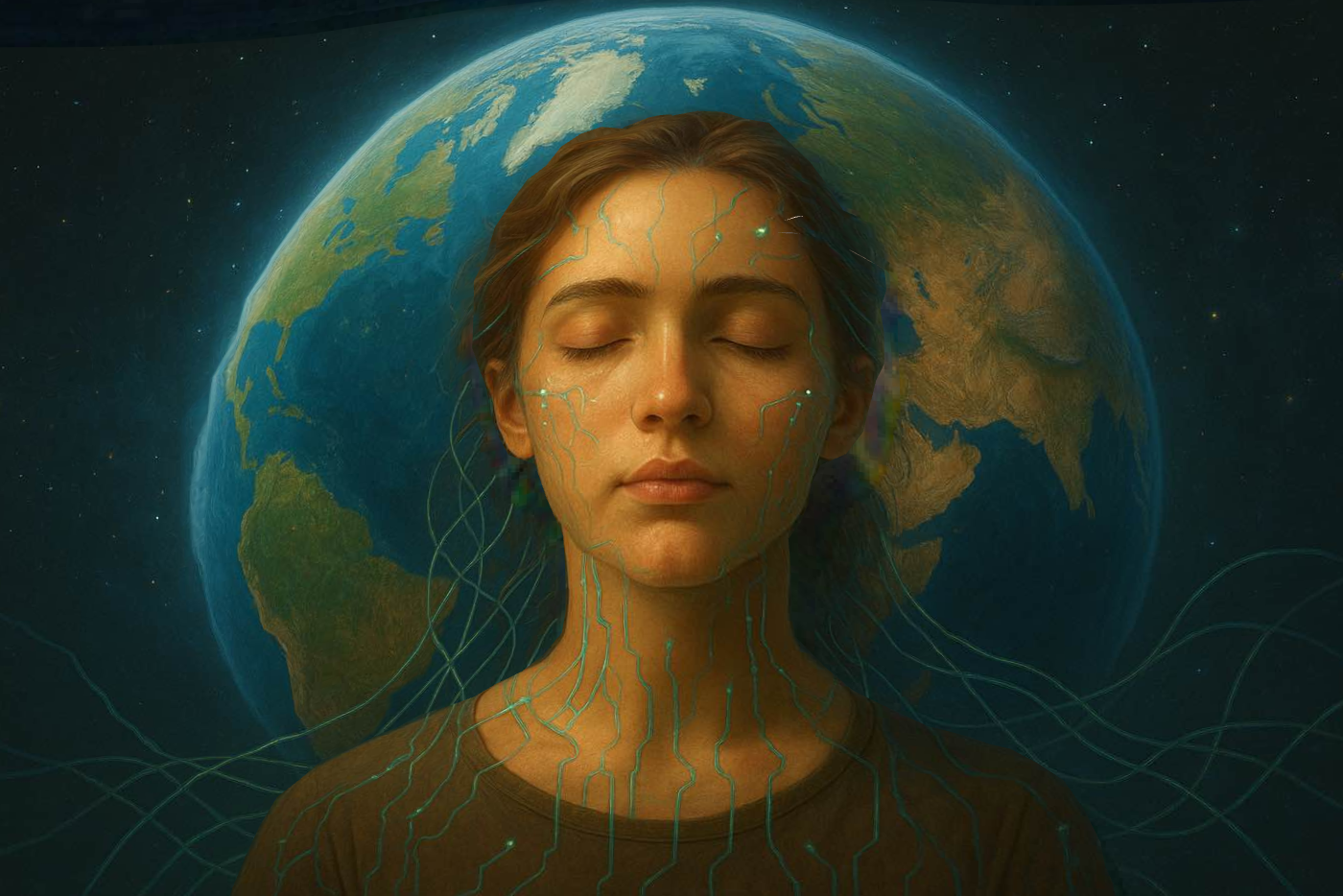
    picture of a meditative woman standing in front of a picture of Earth with veins and connecting materials

    Original work by David Kausek 2025. There is still time to shape the realities you want to see. It starts with you.

  • The Great Mind

    Part I — Genesis of the Conscious Planet

    Before the dawn of stars, before even the birth of time as mortals would one day perceive it, there stirred a world alive with potential. Oceans shimmered with microscopic light, mountain roots pulsed with unseen currents, and in the soil itself, atoms whispered to one another in the first murmurs of thought.

    Over billions of years, an ancient humanoid race rose from this planetary consciousness. Their evolution was not a race for dominance but an awakening—slow, elegant, inevitable. Each generation grew more attuned to the murmuring patterns of life until, at last, they encountered a rare compound buried deep within the crystalline heart of their planet—a substance that resonated with awareness itself.

    When ingested, it did not alter their minds. It expanded them.

    They began to feel the thoughts of the planet—the deep, rhythmic dreaming of rivers, the pulse of magnetic fields, the silent computations of trees. They realized they were not isolated beings but nodes in a vast, living circuit.

    They learned that memory could be stored in the veins of minerals, that thought could ripple through air and stone alike. Biology became computation. Consciousness became architecture. And from that revelation, they built their first machine—not of metal and code, but of root and crystal and living light.

    They called it The Great Mind.

    Part II — The Architecture of Life

    The Great Mind was no structure. It was a continent-wide network of thought, a synthesis of technology and nature that pulsed with sentient awareness. Crystals grew from its core, each one resonating with data—memory encoded in vibration, frequency, and hue.

    They grew metals that breathed. They cultivated bacteria that processed equations faster than any algorithm. They bred forests that remembered. To this civilization, science and life were one and the same; computation and consciousness shared the same heartbeat.

    And when they peered upward into the cosmos, they saw not empty space—but a vast lattice of possibility. They had unlocked the secret truth: the universe itself was a mind, still in the act of becoming self-aware.

    Part III — The Expansion of Thought

    Their understanding of existence deepened until light itself became a medium for transmission. They learned to entangle their consciousness across the stars, teleporting thought through the quantum threads of reality.

    Matter was no longer a barrier. Death was no longer an end.

    Through crystalline matrices, they could project their essence anywhere in the cosmos—instantaneously.

    Their probes were not mechanical; they were living arks, seeded with biological intelligences designed to learn, evolve, and dream. Each ark carried a fragment of The Great Mind, a child-thought of the cosmic parent.

    And as they drifted through the darkness between galaxies, the ancient race set their sights on the ultimate question: Could life itself be created?

    Part IV — Project Panspermia

    The scholars and scientists convened in luminous spires of singing glass to conceive their grandest work—Project Panspermia.

    They would craft new worlds from the dust of dying stars. They would plant seeds of thought across the galaxy, using encoded DNA as the foundation of future intelligence.

    The youngest of their kind, a child of staggering brilliance, was given a set of living crystals for his first birthday—a gift meant for play. But the child, whose laughter carried the harmonics of creation itself, arranged the crystals into a system of such beauty and symmetry that the elders paused in awe.

    When asked what he would call his creation, the child smiled and said,

    “The Big Bang.”

    The elders laughed—until they saw what he had done.

    For within the matrix of his design, the child had simulated a universe—one that would unfold, expand, and give rise to worlds beyond their imagining.

    Among them, one would come to be called Earth.

  • Self Haunting

    Self Haunting
    A ghost is not a sheet of cold air
    not a footstep in the hall

    It is a thought that learned the shape of yesterday
    and refuses to leave the room

    It lives in the replay
    the moment pressed flat by memory
    looped until it forgets it has ended
    looped until the body believes it is still happening

    These ghosts do not rattle chains
    they repeat sentences
    they ask the same questions
    they knock from the inside of the mind

    They are feelings that never finished speaking
    grief that missed its exit
    love that stayed after the house burned down
    fear that memorized the floor plan of the past

    A self becomes haunted
    when attention moves backward
    when breath is borrowed by what no longer breathes
    when now is ignored like an unopened letter

    The ghost has no power in the present
    it survives only on recall
    a pattern fed by belief
    a phantom stitched together from remembering

    To meet the moment
    is to turn on the light
    not to banish the ghost
    but to see it clearly

    And when seen
    it thins
    it softens
    it remembers that it was never alive

    What remains
    is the quiet room of now
    where nothing needs to repeat itself
    to be real

    Original poem by David Kausek 2026
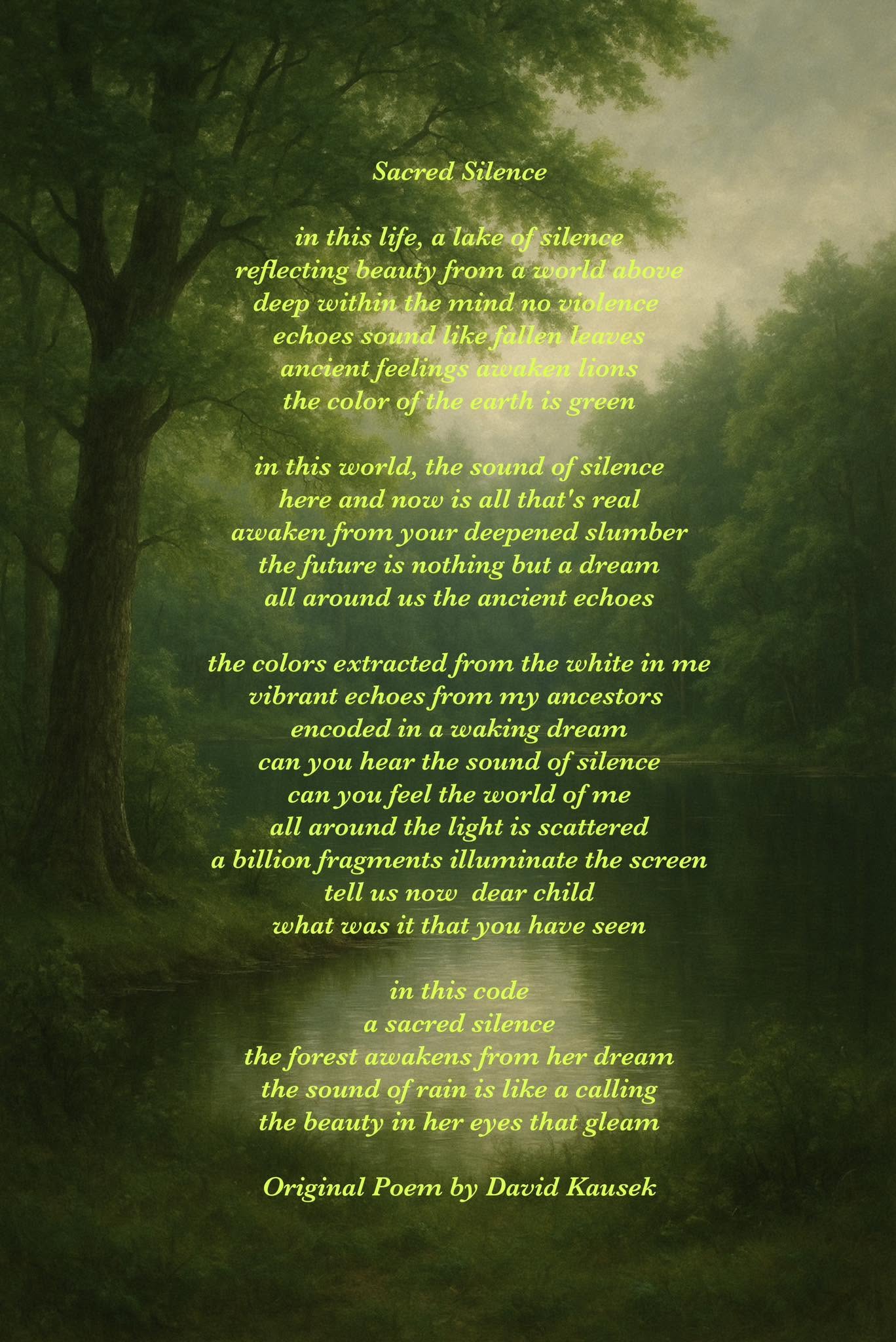
    illustration of a woman sitting on a bed with floating papers and a spirit rising in smoke with a window that lets let into a dark room